Wednesday, 6 May 2009

Toddler Brain Difference Linked to Autism

Story Highlights
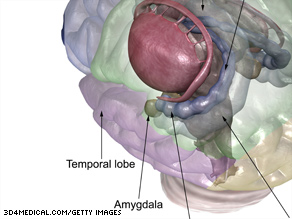
  • Study: The amygdala in toddlers with autism is 13 percent larger than unaffected kids
  • Size of brain area linked to ability to process faces as friend or foe
  • Autism is believed to affect as many as 1 in 150 children
  • University of North Carolina researchers hope findings result in earlier intervention
(CNN) -- The size of a specific part of the brain may help experts pinpoint when autism could first develop, University of North Carolina researchers report.

Using MRI brain scans, researchers found that the area of the brain called the amygdala was, on average, 13 percent larger in young children with autism, compared with control group of children without autism. In the study, published in the latest Archives of General Psychiatry, researchers scanned 50 toddlers with autism and 33 children without autism at age 2 and again at age 4. The study adjusted for age, sex and IQ.

"We believe that children with autism have normal-sized brains at birth but at some point, in the latter part of the first year of life, it [the amygdala] begins to grow in kids with autism. And this study gives us insight inside the underlying brain mechanism so we can design more rational interventions," said lead study author Dr. Joseph Piven. cont...


-

Monday, 4 May 2009

Early autism intervention makes dollars and sense

Early autism intervention makes dollars and sense
By William Frea with Daily Breeze

Posted: 05/02/2009 07:13:13 PM PDT

With one in 150 children today diagnosed with autism, the debate rages on over what is the best treatment for this condition, and - just as importantly - who will pay for it.

In the wake of Autism Awareness Month in April, we have an opportunity to take a realistic and probing look at the most effective means for treating this developmental condition, and where resources should be placed for this treatment.

Today, beleaguered states with budget deficits, such as California, are evaluating all service programs to find ways to cut costs. States need to take a close look at what approaches deliver the best outcomes and the best return on investment. The question is not how much do autism services cost, but how much is saved by treating autism early and effectively, and how much is lost if this early intervention does not occur.

The Autism Society of America has calculated that autism costs the United States more than $90billion each year. There's no question that treatment for autism is expensive. However, there is a significant difference between autism and other severe developmental disabilities. With autism, it's been shown that with targeted early intervention using scientifically validated methods, many children can gain the skills they need to move into a mainstream classroom.

With evidence-based early interventions such as Applied Behavior Analysis, or ABA, the most widely accepted method for treating autism, as many as half of these children would no longer be on the autism spectrum, and most would go on to successful futures as independent adults.

The costs of caring for a person with autism over his or her lifetime is estimated to be at least $3.2 million, according to a study from Professor Michael Ganz at the Harvard School of Public Health. Others have pegged the cost even higher, up to $4.7 million. With ABA therapy averaging $40,000 to $70,000 a year, and most children requiring only several years of therapy starting around age 2, early intervention with this approach clearly delivers an enormous return on investment by avoiding the multi-millions required for lifetime treatment, residential housing and care.

Not included in this cost-benefit estimate is the value that a functioning adult can contribute back to society, or the joy of parents and families who recover the child they thought lost behind the veil of autism. This human benefit is truly priceless.

Unfortunately, California recently opted not to require insurance providers to cover behavioral interventions such as ABA, even though this treatment has been the gold standard for treating autism for more than 30 years. Insurance companies have taken the position that it is education-based rather than a medical treatment.

Other states disagree. Nevada is close to passing legislation requiring insurance companies to fund ABA therapies. Nevada Assemblywoman Melissa Woodbury made a compelling argument citing research that demonstrated 47 percent of children with autism were able to lead independent lives after receiving at least 30 hours per week of intensive ABA early intervention. Nevada would join Arizona, Florida, Illinois, Indiana, Louisiana, Pennsylvania, South Carolina and Texas as states that require insurance providers to cover intensive autism treatments.

We all hope researchers will soon discover the cause of the autism epidemic and how to prevent it. In the meantime, we need to deal with both today's reality and tomorrow's prognosis, as these children move on through middle school, high school and transition to adulthood and careers. The best investment that we can make today is early intervention with scientifically validated ABA therapy.

As policy makers in California struggle with tough financial choices and argue over how much support to give to autism treatments, we urge them to consider not only the dollars and cents of autism, but the dollars and sense. Funding based on the outcomes of evidence-based therapies is the prudent decision for both the short-term and the long-term interests of children with autism, their families and our society as a whole.

Dr. William Frea is chief clinical officer and co-founder of Autism Spectrum Therapies, an agency providing autism services throughout Southern California. He has served on the California State Legislative Blue Ribbon Commission on Autism.

-

Transfer Factor, What Say You?

Recently I have received a lot of email and phone call regarding Transfer Factor, which they claimed to have documented proof to help kids with autism. As a parent from third world or developing country, we have limited information on any method of tools to manage autism. We tend to have "No harm trying" kind of mentality. But that's cost BLOODY a lot of money to just try!

I am setting up this posting call "Transfer Factor, What say you?" and hope I can either cut and paste your experience without mentioning name and  detail. What I want to do is to gather information for the benefit of parents in Malaysia or third world countries especially in Asia.

Please either email me your experience or comment it online anonymously online. Your experience and insight to the above will greatly help.

Regards
Shiok Guy

-

Friday, 1 May 2009

Sad Labour Day

Today is a very sad day for me, not because it is a Labour Day!
Today my elder son beat himself until the front teeth come off.

What kind of force do we need to break this 2 front teeth?
This is not his milk teeth, this 2 are his permanent front teeth.

I cannot imagine a 9 years old boy without his permanent front teeth
Do you think he can wear denture?

I doubt if he can!


I am keeping the 2 front teeth, and hope it can be implanted back.

Can it be done? Please leave your comments and suggestion at the comment section below. I want to know if I can use the teeth for implantation?

Kindly share your experiences and solutions in the comment section, or email to me at shiokx@gmail.com


Sadly,
Shiok Guy
Father of WJ

-

Thursday, 30 April 2009

Parents' Resource for Autism Malaysia (PR4A)

It was informally established more than 10 years ago when a motley group of parents, in light of limited choices and options, decided to actively intervene for their children. They took the initiative to bring in speakers to educate and train themselves on the resources available to help their children. In doing so, they shared what they learnt with other seeking parents. PR4A endeavours to empower parents as they ARE the primary caregivers, spending the most time with their children.


PR4A was formally registered as a society in August 2005 as the members felt that it would be more effective in representing the parents and securing aid. Click here to Visit PR4A

-

Autism Clues


-

Autism researchers announce breakthrough in identifying gene

Autism researchers announce breakthrough in identifying gene

Autism researchers at UM and other universities announced a genetic breakthrough that could lead to improved treatment and prevention of the disorder.

Researchers say they have found the first piece of the genetic puzzle that could lead to greatly improved diagnosis, treatment and even prevention of autism.

A multi-university team, which included the University of Miami School of Medicine, has identified a gene associated with autism, according to a report published Tuesday in the peer-reviewed medical journal Nature. Full article at Maimi Herald

-

Tuesday, 28 April 2009

Insurance Income Plan

The company is going to withdraw the plan from the marketing, and we have only a few days to sign up! This plan is call Income Plus Plan!

We are going to talk about One (1) lot of investment as example based on kid age betweem 1-7 years old.


Yearly Investment = RM9K, for a total of 12 years
  
The 12th Year onward,
Guarantee Return = RM3K per year until the death of the insured.
Non Guarantee Return range from RM2K-RM5K per year. This come with Life Insurance Sum insured at RM50K + Extra RM25K

For More information, Kindly contact me ASAP. Basically we want to use the return after 12th year as constant income for out kid for life. Act Now! Call Yong +60122082818 or email here

-

Saturday, 25 April 2009

Could Autism Be Caused by Lack of Vitamin D?

Could Autism Be Caused by Lack of Vitamin D?

Could autism be caused by low levels of vitamin D? That’s a new idea that’s just starting to emerge, sparked by the large number of autism cases among children of Somali immigrants living in Sweden and Minnesota.

The mothers and young children are exposed to much less sunshine in their new homes than they were back in Somalia. Lighter-skinned people make more vitamin D than dark-skinned people do when exposed to sunshine, so it’s easy to imagine that the Somalis are getting relatively little vitamin D. And because most of the Somali immigrants are Muslim, they cover themselves when going outside, reducing their sun exposure even more. But there’s as yet no clear connection to autism.


Gabrielle Glaser does a great job of exploring this big question in an article posted today at Scientific American online, explaining what scientists know about possible links between autism and vitamin D—and the many things that are still unclear. For instance, there’s no good data on the prevalence of autism in Somalia, so it’s impossible to nail down whether there really is an increase among the immigrant families.

Scientists are just starting to research whether vitamin D could play a role in autism. Their work includes testing pregnant women to find out what their blood levels of vitamin D are, something that’s not routinely done in prenatal office visits.


What’s a parent to do while this research is underway? Because many moms are D-deficient themselves, the American Academy of Pediatrics recently raised the daily vitamin D recommendation for babies and children from 200 IU to 400 IU. My colleague Dr. Bernadine Healy recently explained the debate over women and vitamin D; the consensus is leaning toward a recommended daily intake for adults of 800 to 1,000 IU of the D3 form of the vitamin, far more than the 400 IU in many daily vitamin supplements.


-

Friday, 24 April 2009

I Dreamed a Dream

47 Year old Susan Boyle wows the judges with her performance in the auditions for Britains Got Talent, singing I dreamed a dream from Les Miserables.

Watch her here, and remember to have a tissue box around. Please do share how you feel when you watch this video!


Here are the Lyrics:


I dreamed a dream in time gone by
When hope was high,
And life worth living
I dreamed that love would never die
I dreamed that God would be forgiving.

Then I was young and unafraid
When dreams were made and used,
And wasted
There was no ransom to be paid
No song unsung,
No wine untasted.

But the tigers come at night
With their voices soft as thunder
As they tear your hopes apart
As they turn your dreams to shame.

And still I dream he'll come to me
And we will live our lives together
But there are dreams that cannot be
And there are storms
We cannot weather...

I had a dream my life would be
So different from this hell I'm living
So different now from what it seems
Now life has killed
The dream I dreamed.

-

Thursday, 23 April 2009

Privacy Policy

We use third-party advertising companies to serve ads when you visit our website. These companies may use information (not including your name, address, email address, or telephone number) about your visits to this and other websites in order to provide advertisements about goods and services of interest to you. If you would like more information about this practice and to know your choices about not having this information used by these companies, click here

-

Artists with Autism 2009

Artists with Autism 2009
Art Exhibition - Paintings and Ceramics
Hand in Hand with The Stars


Date: 21st - 28th April 2009 Extended to 2 May 2009

LG2 New Wing, Sunway Pyramid Shopping Mall
The location is now at Entrance of Giant Hypermarket


-

Quote of the Week [20 April 2008]

How – When – Where
By John Oxenham

It is not so much WHERE you live,
As HOW, and WHY, and WHEN you live,
That answers in the affirmative,
Or maybe in the negative,
The question- Are you fit to live?


It is not so much WHERE you live,
As HOW you live, and whether good
Flows from you through your neighbourhood.


And WHY you live, and whether you
Aim high and noblest ends pursue,
And keep Life brimming full and true.


And WHEN you live, and whether Time
Is at its nadir or its prime,
And whether you descend or climb.


It is not so much WHERE you live,
As whether while you live you live
And to the world your highest give,
And so make answer positive
That you are truly fit to live.

-

Tuesday, 21 April 2009

Healing Autism With Horses

Healing Autism With Horses

Erin Trieb for The New York Times  “The Horse Boy” author Rupert Isaacson and his son Rowan in Elgin, Tex.
 
INSERT DESCRIPTION 
In today’s New York Times, reporter Motoko Rich writes about a new book, “The Horse Boy,” that chronicles a father’s trip to Mongolia to ride horses and visit shamans as part of an effort to heal his son’s autism. Ms. Rich asked several top autism experts whether the book offers important insights or false hope for families coping with autism. Here’s what they said: Click Here


-

Depression

Depression is an emotional disorder.  The severity can range from a slight or temporary sorrow to long-term or complete and utter misery. Mental disorders are completely different from physical ones; and are often much more difficult to overcome.


Many different situations and events cause people to become distressed.  That, combined with the headaches of everyday life, can weigh heavily on individuals.

The main causes of depression are drug use, alcohol use, major stressful events, everyday activities if stressful, heredity, sickness and disease and using certain medications.

Continue reading....

-

Inside the mind of a child with autism

The US Centers for Disease Control and Prevention estimates that 1 out of 150 kids have autism, an increase from previous estimates. With autism now more common than pediatric cancer, diabetes, and AIDS combined, if your child isn't on the autism spectrum, chances are good that he or she knows (or will eventually know) someone who is.

April is National Autism Awareness month. We've discussed autism in general and resources for children and adults with ASD, but how do you help your child interact or socialize with someone on the spectrum?
Start by shattering the Rainman myth: Autism may be characterized by varying degrees of impaired social interaction or communication, but a little insight can go a long way toward making social situations easier. For example: "Birthday parties are an ideal way to introduce an autistic kid and his parents to your home," Paul Collins writes in Cookie Magazine, where he offers tips on hosting an child with autism. "They're the stuff he finds logical: presents, cake, things to climb on. What's not to get?"

Ellen Notbohm is the author of Ten Things Every Child with Autism Wishes You Knew, Ten Things Your Student with Autism Wishes You Knew, and The Autism Trail Guide: Postcards from the Road Less Traveled, all ForeWord Book of the Year finalists. She is also co-author of the award-winning 1001 Great Ideas for Teaching and Raising Children with Autism Spectrum Disorders, a columnist for Autism Asperger’s Digest and Children’s Voice, and a contributor to numerous publications and websites around the world.

The mother of a child with autism and another with ADHD, Notbohm's books provide an enlightening glimpse into the minds of children on the spectrum, and have been an eye-opener for many people who are coping with a new ASD diagnosis or wondering how to interact with a child with autism. This excerpt is from Ten Things Every Child with Autism Wishes You Knew and is posted here with permission from the author (please contact her for permission to reproduce in any way, including re-posting on the Internet).
Ten Things Every Child with Autism Wishes You Knew By Ellen Notbohm

-

Child Custody - Bitter Truths

Child custody may be conceptualized as the legal relationship between a child and its parents. It encompasses the right of the parents to care for the needs of the child and to take decisions for the welfare of the child. There are basically two types of child custody; the first is sole custody where the custody of the child is entrusted with only one parent as per the court proceedings and the second is the joint custody where both the parents are entitled to the child custody. During the divorce proceedings, during separation of a couple or the annulment of a legal marriage, such child custody issues may emerge for appropriate dealing.

Continue reading...

-

Ten Things Every Child With Autism Wishes You Knew

Ten Things
Every Child with Autism Wishes You Knew
by Ellen Notbohm
from the book Ten Things Every Child with Autism Wishes You Knew (2005, Future Horizons, Inc.) 
Reprinted in its entirety with permission of author
S
ome days it seems the only predictable thing about it is the unpredictability. The only consistent attribute -- the inconsistency. There is little argument on any level but that autism is baffling, even to those who spend their lives around it. The child who lives with autism may look “normal” but his behavior can be perplexing and downright difficult.
Autism was once thought an “incurable” disorder, but that notion is crumbling in the face knowledge and understanding that is increasing even as you read this. Every day, individuals with autism are showing us that they can overcome, compensate for and otherwise manage many of autism’s most challenging characteristics. Equipping those around our children with simple understanding of autism’s most basic elements has a tremendous impact on their ability to journey towards productive, independent adulthood.
 
Autism is an extremely complex disorder but for purposes of this one article, we can distill its myriad characteristics into four fundamental areas: sensory processing challenges, speech/language delays and impairments, the elusive social interaction skills and whole child/self-esteem issues. And though these four elements may be common to many children, keep front-of-mind the fact that autism is a spectrum disorder: no two (or ten or twenty) children with autism will be completely alike. Every child will be at a different point on the spectrum. And, just as importantly – every parent, teacher and caregiver will be at a different point on the spectrum. Child or adult, each will have a unique set of needs.


Here are ten things every child with autism wishes you knew: 

1.  I am first and foremost a child. My autism is only one aspect of my total character. It does not define me as a person. Are you a person with thoughts, feelings and many talents, or are you just fat (overweight), myopic (wear glasses) or klutzy (uncoordinated, not good at sports)? Those may be things that I see first when I meet you, but they are not necessarily what you are all about.

As an adult, you have some control over how you define yourself. If you want to single out a single characteristic, you can make that known. As a child, I am still unfolding. Neither you nor I yet know what I may be capable of. Defining me by one characteristic runs the danger of setting up an expectation that may be too low. And if I get a sense that you don’t think I “can do it,” my natural response will be:  Why try?


2.  My sensory perceptions are disordered. Sensory integration may be the most difficult aspect of autism to understand, but it is arguably the most critical. It his means that the ordinary sights, sounds, smells, tastes and touches of everyday that you may not even notice can be downright painful for me. The very environment in which I have to live often seems hostile. I may appear withdrawn or belligerent to you but I am really just trying to defend myself. Here is why a “simple” trip to the grocery store may be hell for me: 
My hearing may be hyper-acute. Dozens of people are talking at once. The loudspeaker booms today’s special. Musak whines from the sound system. Cash registers beep and cough, a coffee grinder is chugging. The meat cutter screeches, babies wail, carts creak, the fluorescent lighting hums. My brain can’t filter all the input and I’m in overload! 

My sense of smell may be highly sensitive. The fish at the meat counter isn’t quite fresh, the guy standing next to us hasn’t showered today, the deli is handing out sausage samples, the baby in line ahead of us has a poopy diaper, they’re mopping up pickles on aisle 3 with ammonia….I can’t sort it all out. I am dangerously nauseated.

Because I am visually oriented (see more on this below), this may be my first sense to become overstimulated. The fluorescent light is not only too bright, it buzzes and hums. The room seems to pulsate and it hurts my eyes. The pulsating light bounces off everything and distorts what I am seeing -- the space seems to be constantly changing. There’s glare from windows, too many items for me to be able to focus (I may compensate with "tunnel vision"), moving fans on the ceiling, so many bodies in constant motion. All this affects my vestibular and proprioceptive senses, and now I can’t even tell where my body is in space.


3.  Please remember to distinguish between won’t (I choose not to) and can’t (I am not able to).  
Receptive and expressive language and vocabulary can be major challenges for me. It isn’t that I don’t listen to instructions. It’s that I can’t understand you. When you call to me from across the room, this is what I hear: *&^%$#@, Billy.  #$%^*&^%$&*………” Instead, come speak directly to me in plain words:  “Please put your book in your desk, Billy.  It’s time to go to lunch.”  This tells me what you want me to do and what is going to happen next.  Now it is much easier for me to comply. 


4.  I am a concrete thinker.  This means I interpret language very literally.  It’s very confusing for me when you say, “Hold your horses, cowboy!” when what you really mean is “Please stop running.”  Don’t tell me something is a “piece of cake” when there is no dessert in sight and what you really mean is “this will be easy for you to do.”  When you say “Jamie really burned up the track,” I see a kid playing with matches.  Please just tell me “Jamie ran very fast.” 

Idioms, puns, nuances, double entendres, inference, metaphors, allusions and sarcasm are lost on me. 


5.  Please be patient with my limited vocabulary.  It’s hard for me to tell you what I need when I don’t know the words to describe my feelings.  I may be hungry, frustrated, frightened or confused but right now those words are beyond my ability to express.  Be alert for body language, withdrawal, agitation or other signs that something is wrong. 

Or, there’s a flip side to this:  I may sound like a “little professor” or movie star, rattling off words or whole scripts well beyond my developmental age.  These are messages I have memorized from the world around me to compensate for my language deficits because I know I am expected to respond when spoken to.  They may come from books, TV, the speech of other people.  It is called “echolalia.”  I don’t necessarily understand the context or the terminology I’m using.  I just know that it gets me off the hook for coming up with a reply.


6.  Because language is so difficult for me, I am very visually oriented.  Please show me how to do something rather than just telling me.  And please be prepared to show me many times.  Lots of consistent repetition helps me learn. 

A visual schedule is extremely helpful as I move through my day.  Like your day-timer, it relieves me of the stress of having to remember what comes next, makes for smooth transition between activities, helps me manage my time and meet your expectations.   

I won’t lose the need for a visual schedule as I get older, but my “level of representation” may change.  Before I can read, I need a visual schedule with photographs or simple drawings.  As I get older, a combination of words and pictures may work, and later still, just words. 


7.  Please focus and build on what I can do rather than what I can’t do. Like any other human, I can’t learn in an environment where I’m constantly made to feel that I’m not good enough and that I need “fixing.”  Trying anything new when I am almost sure to be met with criticism, however “constructive,” becomes something to be avoided.  Look for my strengths and you will find them. There is more than one “right” way to do most things. 


8.  Please help me with social interactions. It may look like I don’t want to play with the other kids on the playground, but sometimes it’s just that I simply do not know how to start a conversation or enter a play situation.  If you can encourage other children to invite me to join them at kickball or shooting baskets, it may be that I’m delighted to be included. 

I do best in structured play activities that have a clear beginning and end.  I don’t know how to “read” facial expressions, body language or the emotions of others, so I appreciate ongoing coaching in proper social responses.  For example, if I laugh when Emily falls off the slide, it’s not that I think it’s funny. It’s that I don’t know the proper response.  Teach me to say “Are you OK?”


9.  Try to identify what triggers my meltdowns.  Meltdowns, blow-ups, tantrums or whatever you want to call them are even more horrid for me than they are for you.  They occur because one or more of my senses has gone into overload.   If you can figure out why my meltdowns occur, they can be prevented.  Keep a log noting times, settings, people, activities.  A pattern may emerge.

Try to remember that all behavior is a form of communication.  It tells you, when my words cannot, how I perceive something that is happening in my environment. 
Your browser may not support display of this image.

Parents, keep in mind as well:  persistent behavior may have an underlying medical cause. Food allergies and sensitivities, sleep disorders and gastrointestinal problems can all have profound effects on behavior.


10.  Love me unconditionally.  Banish thoughts like, “If he would just……” and “Why can’t she…..”  You did not fulfill every last expectation your parents had for you and you wouldn’t like being constantly reminded of it.  I did not choose to have autism.  But remember that it is happening to me, not you.  Without your support, my chances of successful, self-reliant adulthood are slim. With your support and guidance, the possibilities are broader than you might think. I promise you – I am worth it. 

And finally, three words:  Patience. Patience. Patience. Work to view my autism as a different ability rather than a disability. Look past what you may see as limitations and see the gifts autism has given me. It may be true that I’m not good at eye contact or conversation, but have you noticed that I don’t lie, cheat at games, tattle on my classmates or pass judgment on other people? Also true that I probably won’t be the next Michael Jordan. But with my attention to fine detail and capacity for extraordinary focus, I might be the next Einstein. Or Mozart. Or Van Gogh. 

They may have had autism too. 

The answer to Alzheimer’s, the enigma of extraterrestrial life -- what future achievements from today’s children with autism, children like me, lie ahead? 

All that I might become won’t happen without you as my foundation. Be my advocate, be my friend, and we’ll see just how far I can go.

© 2005, 2009 Ellen Notbohm


Please contact the author for permission to reproduce in any way, including re-posting on the Internet.

Ellen Notbohm is author of Ten Things Every Child with Autism Wishes You Knew, Ten Things Your Student with Autism Wishes You Knew, and  The Autism Trail Guide: Postcards from the Road Less Traveled, all ForeWord  Book of the Year finalists. She is also co-author of the award-winning 1001 Great Ideas for Teaching and Raising Children with Autism Spectrum Disorders, a columnist for Autism Asperger’s Digest and Children’s Voice, and a contributor to numerous publications and websites around the world. To contact Ellen or explore her work, please visit www.ellennotbohm.com .

-

Friday, 17 April 2009

Sensory Slide Therapy

He is having a good time even when he is whining non-stop.


-

Welcom to My Autism Resource(MAR)

Welcome!

This website/blog is setup to provide support and information for parents, caregivers and professionals in the field of Autism Care. Most of the information and resources are gathered around the web sphere hence MAR does not guarantee the Suitability, Accountability and Accuracy of it's contents at all time.

The website/blog is divided into Main Menu or Main Category and Sub Menu or Sub Category.


The Main Menu or Main Category (A)
  • Home: Going back to the Front Page of this website/blog.
  • News: News items from within Malaysia and around the world.
  • Event: Events announcement and information.
  • Video: Video contents.
  • Photo: Photo contents.
  • Resource: Any autism related resources for the benefit of the readers.
  • Directory: Directory listing of Products and Services.
  • Motivation: Collection of Video, Photo and Article to inspire us. 
  • Directory: Listing of Service Provider, Professional and etc
  • Chatroom: My Autism Resource online Chat Room.
  • Advertise: Find out how you can advertise in MAR
The Sub Menu or Sub Category (B)
  • Book: Information about book on Autism.
  • Documentary: Documentary on related to Autism.
  • Insurance: Information for discrimination of Insurance companies 
  • EIP: Early Intervention Program.
  • ABA: Applied Behavior Analysis
  • Diagnostic: Information on method for diagnosing Autism
  • Exhibition: Exhibition schedule and information related to Autism.
  • Family: Information, products and services related to the Autism family.
  • Personal: Personal or individual information or experiences to share.
  • NGO: Non Governmental Organization.
  • Out Door: Information about our door activities related to Autism.
  • Radio: Information and activities on Radio stations.
  • TV: Information and activities on Television stations.
  • Training:Training Video and information
  • Shop: Buy and Sell of Autism related products, eg. Book and Toy.
If you are a professional and would like your products or services carries and promotes by My Autism Resource, please kindly email to me here or here.

We have created a Yahoo Group too, kindly join as member here.

Click to join MyAutismResource

Click to join MyAutismResource


Yahoo Group Email Addresses


The Managements
My Autism Resource

-

Pump It Up

News clip from KETV on UNO NSSLHA group and their fundraiser for autism.


Autism Awareness


-

Thursday, 16 April 2009

Insurance Cover for Special Children


We all know it is hard if not impossible to insure our special love one. How can we ensure that they can live a quality life with dignity when we are gone?

We have various option like investment with fixed return which help to take care of their financial need. There are options using insurance as a tool as well! I am tasked to make sure that all special need child is covered and their life long financial requirements are fulfill.

I have done the same for both my sons who are suffering from autism! You can do the same too. Call me at the following: -

My Name : Mr Yong Yek Ming (A father of 2 lovely boys suffering from autism)
My Phone : +60122082818
My Email : myautismresource@gmail.com

Regrads
Yong Yek Ming


-

My Son's Experience with Ritalin

Monday, 23 March 2009. WJ first day on Ritalin, 5mg. This is a video documentary of his reaction in school. He took the Ritalin at 7am, school start at 730am. We were are worry about the side effect and also his reaction to the drug.

I hope this documentary will not discourage other parents to start taking the drug. This is only my personal account of my son's reaction.


Taken second dose of 5mg before ABA therapy on 23 March 2009


No appetite for breakfast on 25 March 2009


Self beating on 25 March 2009


ABA Therapy: Play Ball on 25 March 2009


ABA Therapy: Living Skill on 25 March 2009


School Trip to KLCC on 26 March 2009


I week later on 30 March 2009


-

Twitter Delicious Facebook Digg Stumbleupon Favorites More

 
Design by Free WordPress Themes | Bloggerized by Lasantha - Premium Blogger Themes | Facebook Themes